
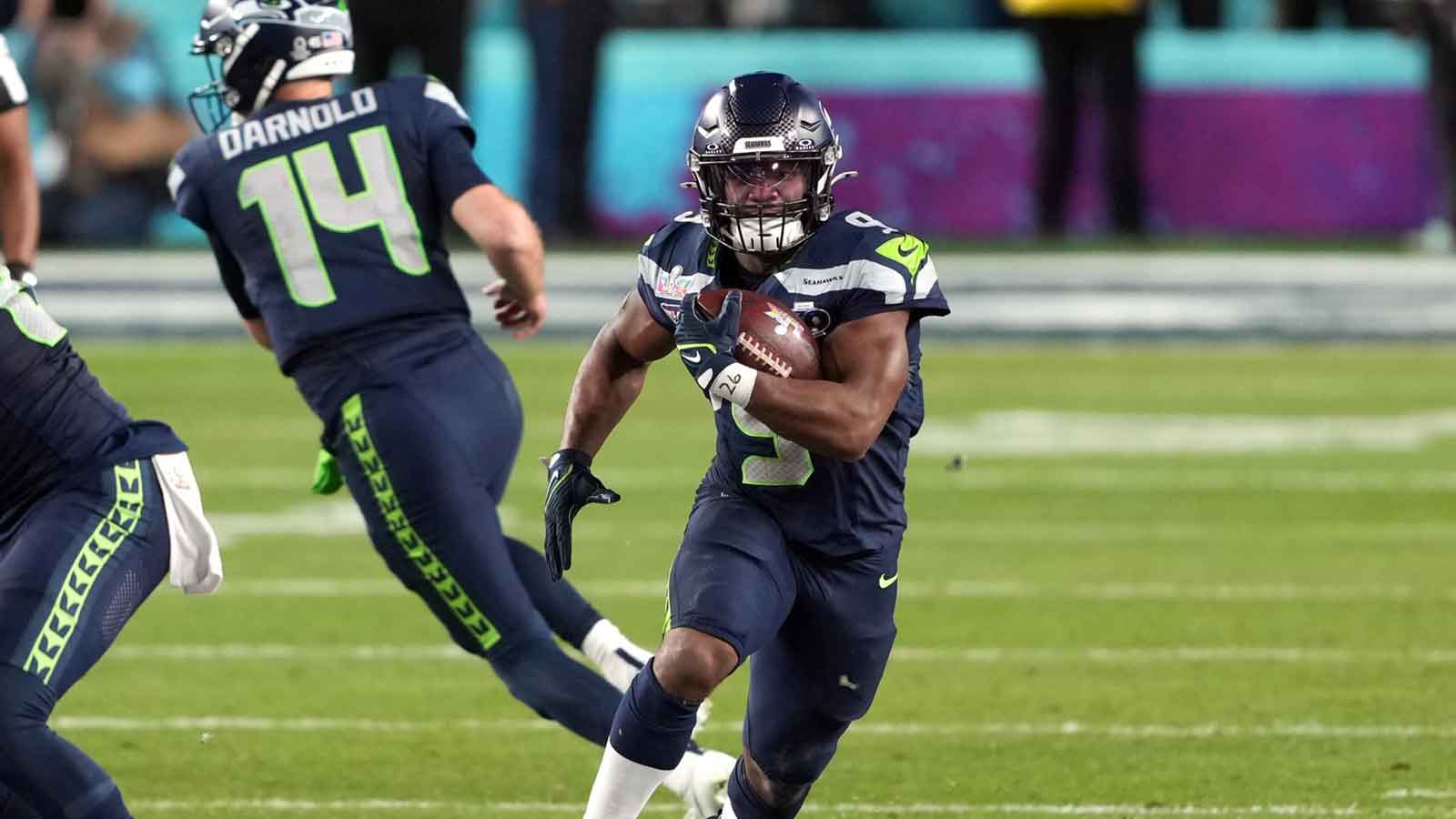
Losing a featured running back often leads to panic among fans, and Seattle’s fan base is no exception. This spring, they faced a significant setback when Kenneth Walker III signed with Kansas City, and Zach Charbonnet suffered a torn ACL during the playoffs.
Mike Macdonald has attempted to temper these reactions publicly, and a meeting with Arkansas running back Mike Washington Jr. has added another dimension to the discussion. The immediate conclusion is that the Seahawks must draft a new starting running back. However, the situation is more nuanced.
With only four draft picks at their disposal, the Seahawks face a challenging scenario.
The picks are numbered 32, 64, 96, and finally 188, and this limited selection means the front office cannot afford to make an emotional decision with their first pick and then improvise for the rest of the draft.
Every choice must serve multiple purposes, as the roster still contains enough championship-level talent to warrant consideration for immediate contributions, but free agency has depleted their depth at running back and other positions.
Given this situation, the draft should be approached sequentially rather than focusing on a single pressing need, and while running back is crucial, so are cornerback, defensive front help, and overall roster depth, especially for a team that wants to avoid the post-title decline John Schneider mentioned when discussing how Seattle assesses its competitors.
The restriction of having just four picks makes the order of these decisions more significant than the specific positions themselves.
This is where bold choices come into play.
Seattle will trade down
Steven Bisig-Imagn Images
Trading down in the draft seems more likely than simply holding steady at pick 32 and making the safest available choice.
The reason is that a team with only four draft selections cannot operate like one that has ample resources, and the Seattle Seahawks possess one first-round pick, one second-round pick, one third-round pick, and a late sixth-round pick, and there is a question in the end: What can they do with those picks?
This is a limited set of choices for a team that has just lost Walker, Boye Mafe, and Riq Woolen in the same offseason, of course, and they need to choose it carefully to not commit any more mistakes for a team aiming for a second championship in a row.
A front office that values competition, as Schneider claims to, should seek more opportunities rather than fewer, and the best way to gain additional picks is at the end of Round 1, where quarterback-needy teams and clubs interested in taking advantage of the fifth-year option often become restless.
Moving down in the draft does not need to be a drastic decision to be significant.
A small slide from pick 32 to the late 30s or early 40s could yield an extra Day 2 or early Day 3 pick, which would be meaningful for this roster, and having one more selection in the middle of the draft would alter the flow of the entire weekend.
It would allow the team to address their defensive needs first while still having the opportunity to select a running back later on. Additionally, it would reduce the pressure to make a pick at a position simply because it has been a topic of discussion in recent weeks.
Another reason to consider trading down is the type of player Seattle typically values. Schneider’s comments in the official running back preview were centered on the mindset of bringing in competitive players who desire an opportunity rather than simply admiring the established stars on the roster.
Teams with this mentality generally prefer to have more options rather than fewer. Thus, a modest slide down the board would align with both the draft strategy and the overarching team-building philosophy.
The first pick will not be a running back
Some fans may dislike this, as the offseason drama seems to suggest otherwise, but with Walker gone, Charbonnet’s status for Week 1 uncertain, and Mike Washington Jr. already having met with the team, it’s understandable that concerns arise about the depth at running back. Mike Macdonald can try to reassure everyone, but the depth chart still appears thin.
Despite these concerns, it seems more likely that the first pick will be used on a defensive player or an offensive lineman rather than on a running back.
The rationale lies in the draft board, of course, and while running back is indeed a position of need, it is not the only one.
Seattle’s draft strategy emphasizes the importance of positional value, and by the end of the first round, teams often find themselves choosing between a premium defender and a skill player who might not significantly outperform what’s available later.
Seattle is well aware of this dynamic, especially since the official draft preview mentions that the team has been willing to draft backs early in the past, including Walker and Charbonnet in the second round and Rashaad Penny in the first.
This history shows that the Seahawks are not afraid to invest significant resources in the running back position, yet they also understand the importance of board order.
The most compelling football argument is to allocate the first pick to a position that has less depth.
Cornerback is one option after Woolen’s departure, while the defensive front remains a concern following Mafe’s exit, and a team that aims to compete should be cautious about spending its highest pick on a running back when a more impactful pass rusher or a higher-quality defensive back is available.
Seattle can endure a little more uncertainty in the backfield than it can a weaker front or secondary when the season begins.
Macdonald’s public demeanor also matters more than many realize.
Coaches often say a lot, but his comments were particularly telling, as he mentioned Holani’s late-season performance, Charbonnet’s established production, and the potential return of Kenny McIntosh, while also noting that the team would always look for opportunities to improve.
This does sound like a coach acknowledging that the position needs to be addressed, but not necessarily as a top priority.
Mike Washington Jr. will be in this class
© Kirby Lee-Imagn Images
Mike fits well with Seattle’s needs as the draft board aligns with their position, and his recent meeting with the team is relevant background information, especially considering Matt Miller’s comments linking it to the club’s search for a replacement for Kenneth Walker.
However, the more important detail is the type of player Washington is, and Seattle’s official running back preview ranks him third at the position, behind Jeremiyah Love and Jadarian Price.
They project him to be selected in the second to third round and describe him as a size-speed back with an “intoxicating combination” of frame and breakaway ability. This profile is precisely what a team like Seattle should value at this point in the draft.
Washington presents a different solution to the same overarching question: How does the offense maintain a dangerous ground game while Zach Charbonnet recovers and the team adjusts to losing its most explosive runner?
Additionally, Seattle does not need a one-dimensional replacement. Charbonnet, when healthy, provides power and scoring capability, and Wilson adds another sturdy option to the backfield.
What the team requires is a running back with enough speed to alter pursuit angles and sufficient size to handle a heavy workload if needed early in the season, so Washington fulfills these criteria better than many of the later options available.
Furthermore, he fits naturally into the part of the draft where Seattle can act effectively without disrupting their overall strategy.
If the team decides to trade down from the 32nd pick, Washington becomes a clean target for the second day, but if they stay at the end of the first round and use their next pick on a different position, he still makes sense at either pick 64 or even 96, depending on how the draft unfolds.
The official preview’s ranking of him as a second-to-third-round player aligns with this plan perfectly.
The post Seahawks’ bold predictions in 2026 NFL Draft appeared first on ClutchPoints.