Tatsuya Imai’s slider was one of the great baseball mysteries early this season before he went on the IL.
A backward slider? A pitch that darted half a foot arm side instead of glove side? How is that possible?
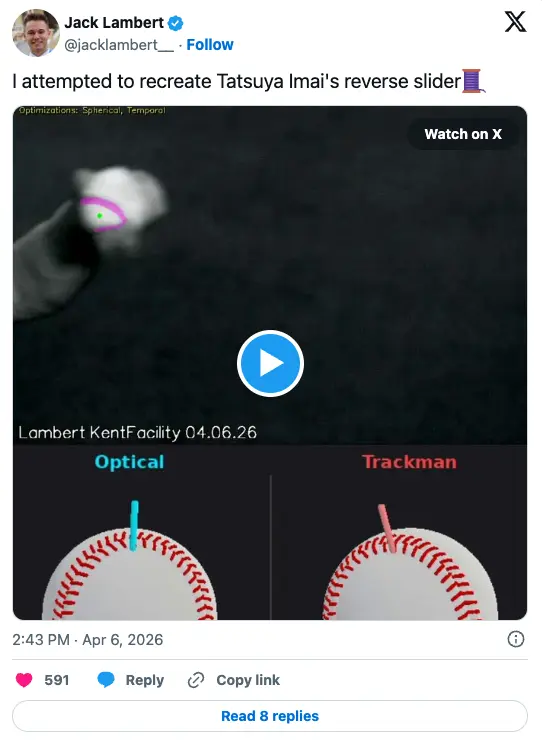
Driveline’s Jack Lambert was among those fascinated when he learned about the pitch Imai brought from Japan to the Houston Astros this offseason. Lambert became interested in investigating the offering when he saw a screenshot of Imai’s pitching hand at the release of the outlier offering.
“You could see with the camera angle from behind that he’s actually throwing it by getting underneath the baseball rather than on top of it, which I thought was unique,” Lambert said. “Because every backwards slider, or screwball-type pitch I’ve seen is going over the top, and kind of getting there by pronating.”
Lambert decided to jump in the Driveline lab and experiment.
While Lambert is a data scientist and baseball analyst by trade — his playing career ended after high school — he has enough throwing ability to experiment.
Could he come anywhere near replicating the Imai slider? And if he could, he reasoned, that meant others with far more pitching expertise, like professional and high-level amateur pitchers and coaches, would be able to learn and repeat it.
And rather than searching in the dark, he had some help: the next generation of pitch design being engineered at Driveline Baseball.
About a decade ago, Driveline pioneered pairing high-speed, Edgertronic cameras – which were not designed for baseball, rather, for scientific research like studying kangaroo rats – with ballistic pitch data from Trackman to create what became known as modern pitch design.
It’s allowed for smarter practice, fewer wasted reps, and far less guessing. Pitch design science has been incredibly effective in allowing pitchers to more quickly design new offerings, and sharpen existing ones, through a data- and visual-based feedback loop. It’s proliferated through professional and amateur baseball.
But as big of a breakthrough as Pitch Design 1.0 was, it did not capture all information, all effects on ball flight. It could not explain all pitch movement. While Trackman does offer observed spin axis and measures, which does get to seam-shift qualities, what it cannot do is inform quantitatively whether a movement – or how much of a movement – was created by magnus or non-magnus forces.
Outside of affiliated professional baseball, players and coaches and data analysts at places like Driveline do not have access to complete Hawk-Eye data. That matters because the public Hawk-Eye data does not include access to seam orientation or spin-based spin axis – only the observed spin axis.
This is in part why we are working to usher in the next iteration of pitch design that is aided by real world AI from our computer vision system.
And that’s where Imai’s backward slider comes in.
One way in which computer vision holds immense potential is having coaches and pitchers better understand how another pitcher is creating a shape.
“The first computer vision helper was Sam (Ehrlich) who ran (video of the pitch) through our CV model to get the spin axis, and seam orientation that Imai was creating to set as a rough target for what I should be aiming for,” Lambert explained.
In the video above, Lambert shows how the CV tool identifies the balls’ spin axis with a neon green dot and the seam orientation in other neon hues.
“I think that’s probably the most applicable use of CV at this point is that… getting some of the metrics I can’t get from Hawk-Eye,” Lambert said. “I’m sure you can imagine if my high school brother in Cincinnati is throwing a bullpen and just doesn’t have a Trackman available, if we can get some footage, get some estimates for what’s going on, we can better like adjust that process from there.”
A computer vision system learns by analyzing thousands upon thousands of labeled images – sometimes even millions like in the case of something Tesla’s early self-driving efforts – using convolutional neural networks to then identify patterns and understand spatial hierarchies. This is deep learning.
Boddy and others at Driveline did tons of labeling, heavy lifting, to train the system – labeling seams, spin axis, and pitch types of thousands upon thousands of recorded offerings. The system is still learning, it’s still getting better.
Lambert made about 50 throws earlier this month, studying the ball flight and impact of each adjustment guided by feedback from Driveline’s real-world AI effort.
He wasn’t able to perfectly replicate the pitch in one bullpen, but he was able to mimic some of its characteristics after just one grip and release recommendation from our computer vision model and some tweaking.
“What I was able to recreate was I could get the high, arm-side run that he would throw,” Lambert said. “I could not kill the spin efficiency enough to get the gyro action. I found it easier to basically create a changeup profile with a supinated (release) than to create the true gyro version of his slider. That was most of the iteration process. It actually didn’t take that long to produce some pitches with the high, arm-side run.”
Imagine what actual pro and college pitchers and coaches might be able to do with the tool?
That is one application of a computer vision model: helping coaches and players understand how to begin with a pitch.
Driveline’s pitching director Connor White explains the other great benefit of deep-learning aided pitch design.
“The speed of analysis is one of the most exciting things,” White said. “We want to keep those pens game-like. So, if that’s having to stop after every pitch and look at a bunch of metrics and consult the video, and next thing you know it’s been a minute between pitches or more it really kind of breaks that flow… The computer vision allows you to look at the observed versus like spin-based (movement), getting the closer to the ball physics of what’s happening in real time.
“The speed at which these (advancements) can be applied is just so exciting.”
Shortening the feedback loop, the understanding of what a pitch is doing, is indeed exciting.
Our computer vision model is not a finished product, but it is already having results in our gyms.
Driveline pitching trainer Grayson Liebhardt says it’s already helping him as a coach.
“It’s a really helpful tool,” Liebhardt said. “It’s earlier in development but it’s helping us bridge the gap, and understand seam orientation without any access to the data that the pro organizations have… It gives us just more context on why a pitch may move a certain way, or, how to optimize seam orientation for certain movement profiles.
“Pitch physics isn’t completely solved. There’s a lot of stuff, non-Magnus wise, like seam-shifted wake, and possibly other variables that we may not even know about, that affect ball flight,” Liebhardt said.
For instance, Liebhardt notes we know how seam-shifted wake affects ball flight but we cannot quantify how much it affects movement alongside other variables, some he notes that “we may not even currently consider.”
We don’t know everything. And what’s so exciting is computer vision will lead to more understanding.
“These tools are super helpful for utilizing the information that we already have,” he said of CV, “as well as collecting more information to be able to learn more about pitch physics.”
What’s also exciting about real-world AI breakthroughs is they keep learning, they keep getting better.
“The cool part for me is being able to have an easier way to look at seam orientation and spin axis,” Liebhardt said. “That’s just something that, historically, you’d have (study an) Edgertronic camera and try and find it and guess where the spin axis would be.”
Now, Liebhardt has a tool that cuts out more of the guessing.
He shared this clip of another Imai-like mystery pitch, this one from Driveline athlete Tony Oreb.
We can again see how the CV has learned to identify and mark the axis and seams to allow a fuller understanding of the pitch’s flight.
Liebhardt responded to Lambert’s efforts with new insights observed from the CV model: “Different orientation than yours and Imai’s. Can be done with a (four-seam) and (two-seam) orientation?”
We are already gleaning new insights and helping athletes with the next generation of pitch design. While our pioneering efforts have already helped pitchers and coaches develop scores upon scores of pitches, the new generation – a real-world AI effort – promises even more. It’s part of the Driveline process: constant iteration, and constant improvement.
The post Investigating a mystery pitch as a test case for a new (computer) vision for pitch design appeared first on Driveline Baseball.