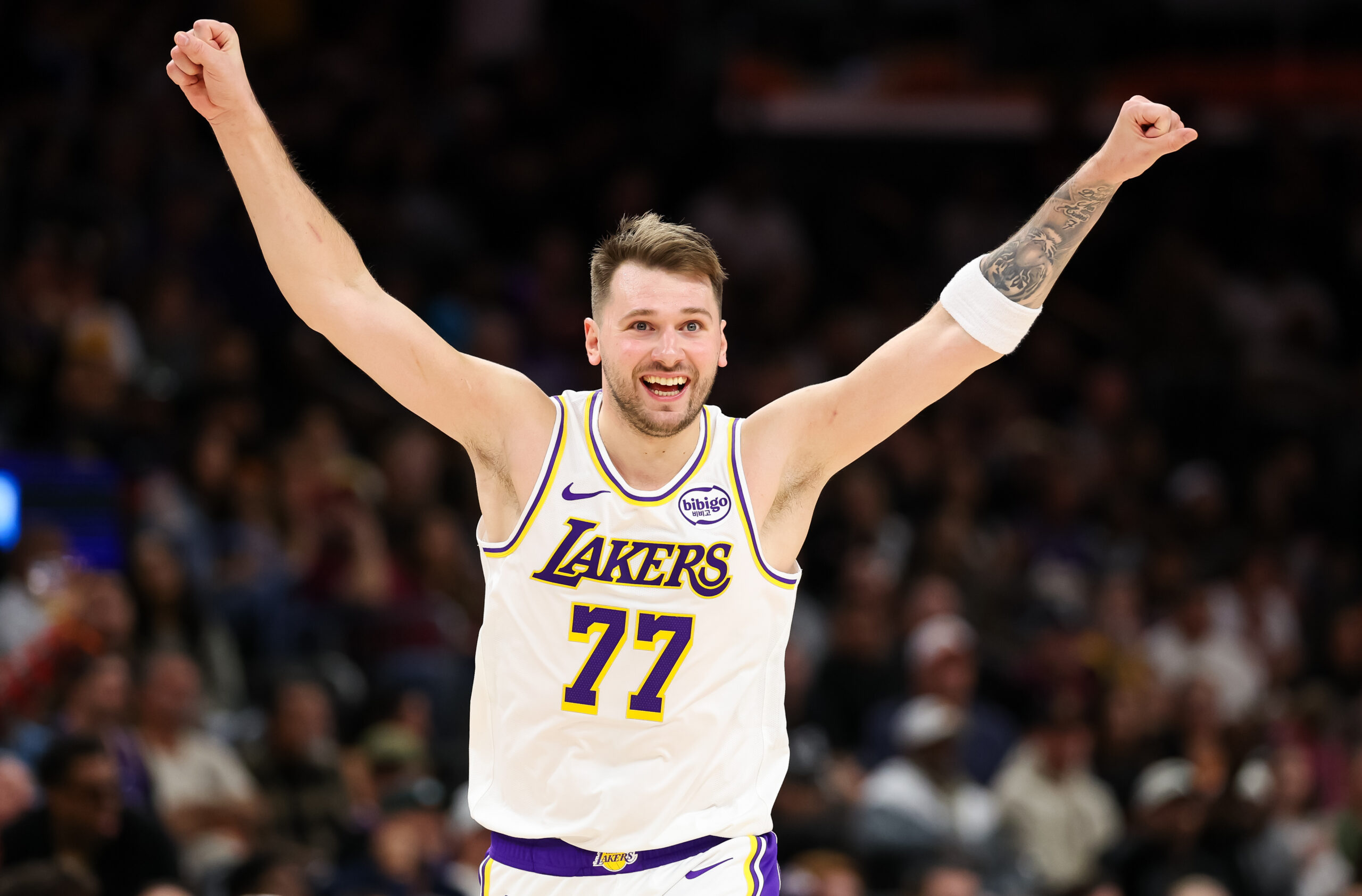
The scene felt familiar even before the opening tip. Fans navigated icy roads and freezing temperatures across North Texas to fill American Airlines Center, drawn by the weight of a return that still carries consequence. When Luka Dončić walked back into the building Saturday night, it was no longer as the franchise centerpiece of the Dallas Mavericks, but as the engine of the Los Angeles Lakers — and this time, the moment arrived without ceremony.
(Photo by Mike Christy/Getty Images)
There was no tribute video. No long pause to let emotion crest. Just a standing ovation during introductions, a quick acknowledgment from Dončić, and then a pivot toward the stakes of a Western Conference race that now places him on the other side.
By the end of the night, the result felt definitive. Dončić posted 33 points, eight rebounds, and 11 assists, then closed the game with a defensive charge that punctuated a 116–110 Lakers comeback win. The performance sealed Los Angeles’ fourth straight victory over Dallas since the trade and reinforced how these returns have evolved — from emotional reckoning into something far more procedural.
The Trade That Still Frames Everything
Saturday marked Dončić’s second game back in Dallas since the blockbuster deal that sent him to Los Angeles nearly a year ago, reshaping both franchises’ timelines. The Mavericks acquired a rehabbing Anthony Davis and young guard Max Christie in the deal, betting on a recalibration rather than a rebuild. The Lakers acquired a franchise-defining star and built quickly around him.
The matchup now carries layers that extend well beyond nostalgia. Saturday’s win kept Dončić perfect at 4–0 against his former team, a run that spans two meetings in Dallas and two in Los Angeles. Christie, part of the return package, finished with 24 points on 9-of-16 shooting for Dallas, while Naji Marshall added 21 points and 11 rebounds — reminders of how intertwined the two rosters remain because of that transaction.
Unlike Dončić’s first return last season, when he wiped away tears during a tribute video on the bench before his introduction, this visit arrived quietly. The crowd acknowledged him, then quickly shifted its energy back to the game itself.
If last season’s return froze the building in memory, this one unfolded inside the normal rhythms of competition.
Luka got emotional watching his tribute video from the Mavs pic.twitter.com/ySim9PqNUg
— NBA TV (@NBATV) April 9, 2025
Early Control Belonged to Los Angeles
The Lakers dictated the opening terms with pace and pressure. Dallas turned the ball over five times in the first quarter, and Los Angeles converted those mistakes into early separation. Dončić scored 12 points in the opening period, and the Lakers closed the quarter on a 16–8 run to lead 37–28.
The advantage was not built on shot-making alone. Los Angeles played downhill, forced mismatches, and lived at the free-throw line. The Lakers went 9-of-12 at the stripe in the first quarter and hit 4-of-9 from three, while Dallas struggled to establish a clean offensive base.
By halftime, Los Angeles led 65–52 behind 17 points and seven assists from Dončić. His line underscored how the game was unfolding: just 3-of-7 from the field, but 9-of-10 at the free-throw line, manipulating help defenders and dictating matchups rather than hunting jumpers.
LeBron James said afterward that the Lakers never viewed the halftime swing as decisive, even as the game tightened.
“Sometimes the game is a game of runs,” James said. “We still had time. Starting the fourth, we knew we had time to make a push.”
Dallas’ Surge After Halftime
If the first half belonged to Los Angeles’ pressure, the third quarter belonged to Dallas’ urgency.
The Mavericks ripped off a 41–14 surge from the start of the third quarter into the opening minutes of the fourth, flipping a 13-point deficit into a 14-point lead. Brandon Williams poured in eight points to close the third, and the building came alive as Dallas finally found pace.
Caleb Martin sparked the run with a steal and fast-break layup. Cooper Flagg buried a three, then found Christie for another. Marshall finished in transition after stripping Dončić. Dallas took its first lead since early in the opening quarter and entered the fourth ahead 88–79.
From the Lakers’ bench, head coach JJ Redick framed the stretch as an execution breakdown rather than a loss of intent.
“We had seven turnovers in the quarter and missed three layups,” Redick said. “Those turnovers allowed them to get out and run.”
Luka Dončić gets to the rim for a layup to cut the Mavericks’ lead to 104-101 with 3:17 to play in the fourth quarter.
Dončić has 29 points, 8 rebounds, 10 assists on the night. pic.twitter.com/I1hD03LcSH
— Grant Afseth (@GrantAfseth) January 25, 2026
When the Game Tilted Back
Dallas still led by 15 with under seven minutes remaining. Christie’s free throws with 2:58 left gave the Mavericks a 106–101 cushion, and the path to closing appeared straightforward.
Instead, the margins collapsed possession by possession.
The Lakers closed on a 29–8 run to finish the game, with Dončić and James orchestrating nearly every half-court trip. Rui Hachimura ignited the swing with a four-point play from the left wing, then drilled another three on the next possession to give Los Angeles the lead for good. A third deep three pushed the Lakers ahead 108–106 and started the final 11–2 burst.
James, who sat at a minus-28 earlier in the fourth quarter, scored 11 of his 17 points in the final period as the Lakers tightened defensively and stopped turning the ball over.
Jason Kidd was blunt in his assessment.
“I think defensively we couldn’t get stops, and offensively we were one for nine,” Kidd said. “Turnovers led to them capitalizing.”
A Defensive Finish That Stood Out
As Dallas searched for answers late, it repeatedly targeted Dončić defensively, dragging him into space with Christie and Williams screening to force switches.
The result surprised no one in the Lakers’ locker room.
According to Redick, Dončić finished six straight defensive possessions without yielding a basket. The defining moment came with 41.8 seconds left. Dončić had just driven for a layup to stretch the lead to eight. On the next trip, he beat Marshall to the spot on a straight-line drive and absorbed the contact for a charge.
“The charge, for sure,” Dončić said when asked which moment he enjoyed more. “I enjoyed the charge more.”
Redick called Dončić “fantastic” defensively and pointed to that sequence as emblematic of the accountability the Lakers have pushed since December.
For a player long critiqued for his defense and body language, it was a different kind of statement — one defined by positioning and anticipation rather than scoring.
Familiarity Without Disruption
Dončić acknowledged that returning to Dallas still carries emotion, but he also made clear that it no longer dictates his night.
“There’s always going to be emotions,” he said. “But it was a little bit easier for me this time.”
The reception reflected that shift. The cheers came quickly, then faded into competitive noise. The loudest reactions arrived when he missed, a sign that nostalgia has begun giving way to edge.
That comfort has translated into consistency. Across four career games against Dallas since the trade, Dončić is averaging 33.0 points, nine rebounds, and 10 assists while playing more than 38 minutes per game. He has shot better than 50 percent from the field, over 44 percent from three, and 86 percent from the free-throw line in those meetings.
His first visit back to Dallas as a Laker, in April, set the tone: 45 points on 16-of-28 shooting, seven made threes, and an offensive display that felt less like catharsis and more like routine dominance.
Luka Dončić connects with Dereck Lively II after the Lakers-Mavs game. pic.twitter.com/oSWaCWVrOf
— Grant Afseth (@GrantAfseth) January 25, 2026
What It Means Going Forward
Saturday’s loss snapped Dallas’ season-best four-game winning streak and came with added logistical strain. Weather issues forced the Mavericks to delay their flight to Milwaukee until Sunday morning ahead of a back-to-back against the Bucks.
For Los Angeles, the win came on the front end of an eight-game trip that Redick has framed as a measuring stick for their surge. The Lakers improved to 27–17 and remain perfect this season when leading at halftime.
The broader takeaway, though, extends beyond one night or one result. Dončić has never downplayed what Dallas means to him.
“This is always going to be a special place,” he said. “A lot of things happened here — good and bad.”
But the distinction has become clearer with each return. Special does not mean destabilizing. The first visit was about memory and meaning. This one — for both sides — was about standings, habits, and a star who now treats nights in Dallas as familiar ground rather than emotional terrain.
When Dončić comes back now, the emotions are real, but the disruption is gone.
The post Inside Luka Dončić’s Return to Dallas, No Longer Defined by Shock appeared first on Ballislife.com.