
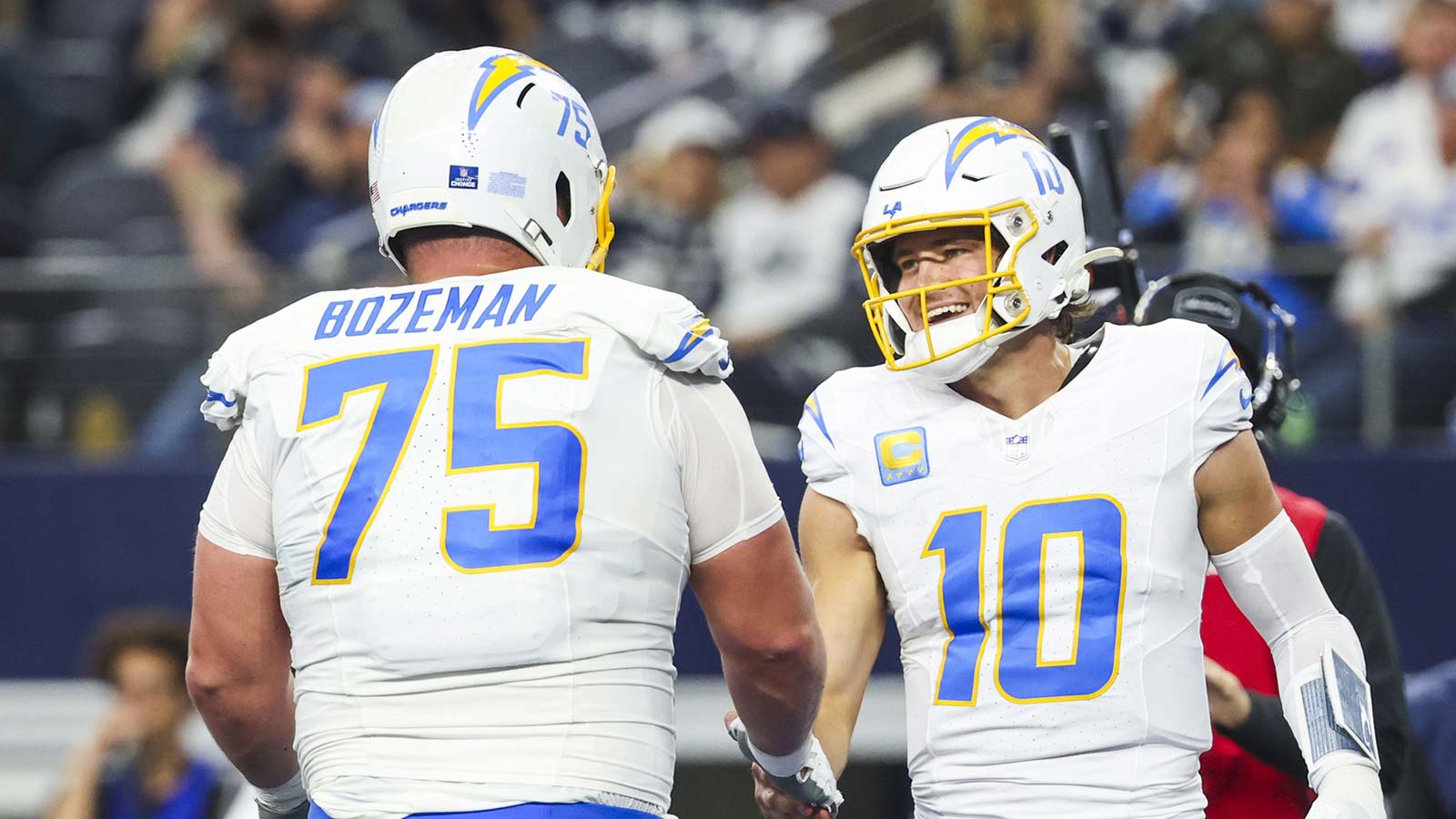
Recently, some developments have made it easier to assess the Los Angeles Chargers’ draft strategy. Bill Barnwell’s all-trades mock draft suggested that Quentin Johnston could be traded to Carolina, which was notable not only for the specific trade scenario but also for what it indicates about the current perception of the Chargers.
They also made a great investment in the defense line with the arrival of Dalvin Tomlinson, too, and it seems that their roster has movable parts, and the front office is seen as flexible rather than locked into a single approach.
Conversely, most standard mock drafts have not focused on wide receivers. Instead, many analysts are emphasizing the importance of positions along the line of scrimmage, particularly for the defensive front and the interior offensive line.
This focus makes sense given that ESPN’s latest team-specific draft intel reveals that the Chargers have the second-lowest number of picks in this draft class, tied with Atlanta.
As a result, every early decision is more critical than usual, and with limited room for error, analysts are treating Los Angeles as a team that requires an immediate starter or a solid rotational contributor, rather than a luxury pick or a long-term project.
Here’s where the pre-draft landscape stands now, based on direct projections from analysts.
DT Peter Woods, Clemson
Kirby Lee-Imagn Images
In Mel Kiper Jr.’s first-round mock draft, he projected that the Chargers would select Peter Woods.
Kiper explained that the team addressed the interior offensive line before the start of free agency, allowing them the freedom to focus on the defensive line with their first selection. He described Woods as a high-upside 3-technique player whose production dipped last season, but whose potential as an interior disruptor still makes him suitable for a late first-round pick.
This projection highlights the overall assessment of the draft class, and if a national mock draft can assume that the Chargers sufficiently improved their offensive line to pass on a guard or tackle in Round 1, it suggests that the defensive interior is being taken seriously as a first-pick option.
Woods fits the profile of players typically available in this range: not a polished star yet, but a premium athlete at a crucial position who wouldn’t need to carry the pass rush on his own right away. For Los Angeles, this is great because they need a player who can immediately integrate into a stronger rotation and develop further.
OG Olaivavega Ioane, Penn State
© Mark J. Rebilas-Imagn Images
Tim Crean’s mock draft took a more aggressive approach by moving the Chargers up from the 22nd to the 18th pick to select Penn State guard Olaivavega Ioane. He reasons that too many teams in that section of the draft might be interested in taking the best true guard available, so if Los Angeles wanted Ioane, they shouldn’t risk staying in their current spot.
His projection directly addresses two prominent concerns for the Chargers: improving the run game and shielding quarterback Justin Herbert from the kind of interior pressure that has disrupted too many drives in recent seasons.
Among the more offensively oriented projections connected to the Chargers, this one stands out as being particularly clear-cut. Ioane is seen as someone worth trading up for, which carries significant weight in a year when the Chargers have so few draft selections.
A team with limited picks must decide whether to trust the existing board or take action to shape it. Crean’s mock draft leans towards taking action, and the choice to do so for a guard indicates a strong belief that the Chargers’ interior line remains an unresolved issue.
EDGE T.J. Parker, Clemson
Kirby Lee-Imagn Images
Jordan Reid did not make a standard one-round projection for Los Angeles in his latest Chargers-specific draft analysis, but his “ideal picks” column provides a clear insight into how ESPN interprets the draft board.
Reid’s preferred choice for the Chargers in the first round was T.J. Parker, followed by Oregon guard Emmanuel Pregnon in Round 2. He noted that edge rusher and interior offensive line are two major needs for the roster, describing Parker as a heavy-handed, powerful run defender with the potential to be a complementary pass rusher.
Reid also highlighted that Los Angeles is working with one of the smallest pick totals in the draft, making the prioritization of their needs especially important.
The ideal format is beneficial because it eliminates some of the mock-draft theatrics and approaches how a team might genuinely evaluate the situation. Parker may not be the flashiest edge rusher linked to the Chargers, but Reid’s argument for him is based on his profile, reliability, and the understanding that the Chargers need help at a position that still lacks certainty behind the veterans.
This perspective differs significantly from simply selecting the most explosive pass rusher available. Reid’s choice of Parker first and Pregnon second also reflects a broader trend within the Chargers: the front office is perceived as a team likely to divide its early focus between addressing the defensive front and strengthening the offensive interior rather than concentrating all efforts on one side of the ball.
EDGE Keldric Faulk, Auburn
Kirby Lee-Imagn Images
Josh Edwards’ seven-round mock draft begins the Chargers’ class with Auburn edge rusher Keldric Faulk, followed by Iowa interior lineman Gennings Dunker and Georgia cornerback Daylen Everette.
Although the selection summary lacks an extensive written explanation, the order itself is indicative, and Edwards assesses Los Angeles as a team that should prioritize the edge position first, then pursue offensive line help, and finally add secondary depth on Day 2.
Faulk stands out among these others because he represents a traditional approach to the Chargers’ first-round decision, and while some analysts suggest options that focus more on the interior or offensive positions, Edwards emphasizes the necessity for a comprehensive long-term strategy at the edge.
In this context, Faulk embodies the viewpoint of evaluators who see the roster as needing a premium investment in a crucial position, rather than viewing it as a space needing just one additional rotational piece.
EDGE Cashius Howell, Texas A&M
Jerome Miron-Imagn Images
Chad Reuter’s five-round mock presents an intriguing scenario where the Chargers trade down in the first round. In his scenario, Cleveland moves up two spots and grants Los Angeles a fifth-round pick that they currently lack, along with an additional sixth-rounder.
After trading back, the Chargers still managed to select Texas A&M edge rusher Cashius Howell. Reuter’s rationale is that while Khalil Mack has re-signed for one year, the team still requires a future starter, and Howell could enhance the pass rush immediately, even if he takes time to become an every-down player.
And this all is noteworthy because it illustrates another way to interpret the draft situation.
The Chargers do not necessarily have to choose between targeting an edge rusher and seeking value, and if the situation warrants, they could move down the draft board, recover picks, and still secure a front-seven player with a defined role.
Reuter’s mock also serves as a clear reminder that Los Angeles’ lack of draft capital does not inherently force the team to hold their current position, and in a draft class where specific positions repeatedly appear in mocks, there’s a solid argument for trading back if the front office believes that acceptable edge or defensive line targets will still be available a few spots later.
What unifies all these is not a singular player but rather the overall shape of the draft board, and the strongest mock drafts for the Chargers are not primarily debating whether Los Angeles should target a wide receiver or a surprise offensive skill player in the first round.
Instead, they are focused on determining which trench or front-seven issue should be prioritized first, and whether that should be addressed by standing pat and moving up, and while some scenarios hint at flexibility, the core of the current mock draft cycle remains simpler: With so few picks, the Chargers are viewed as a team that needs one solid early selection more than several flashy ones, which is why similar positions continue to appear throughout the analyses, even as the specific players change.
The post Chargers’ 2026 NFL Mock Draft roundup with pre-draft cycle ending appeared first on ClutchPoints.