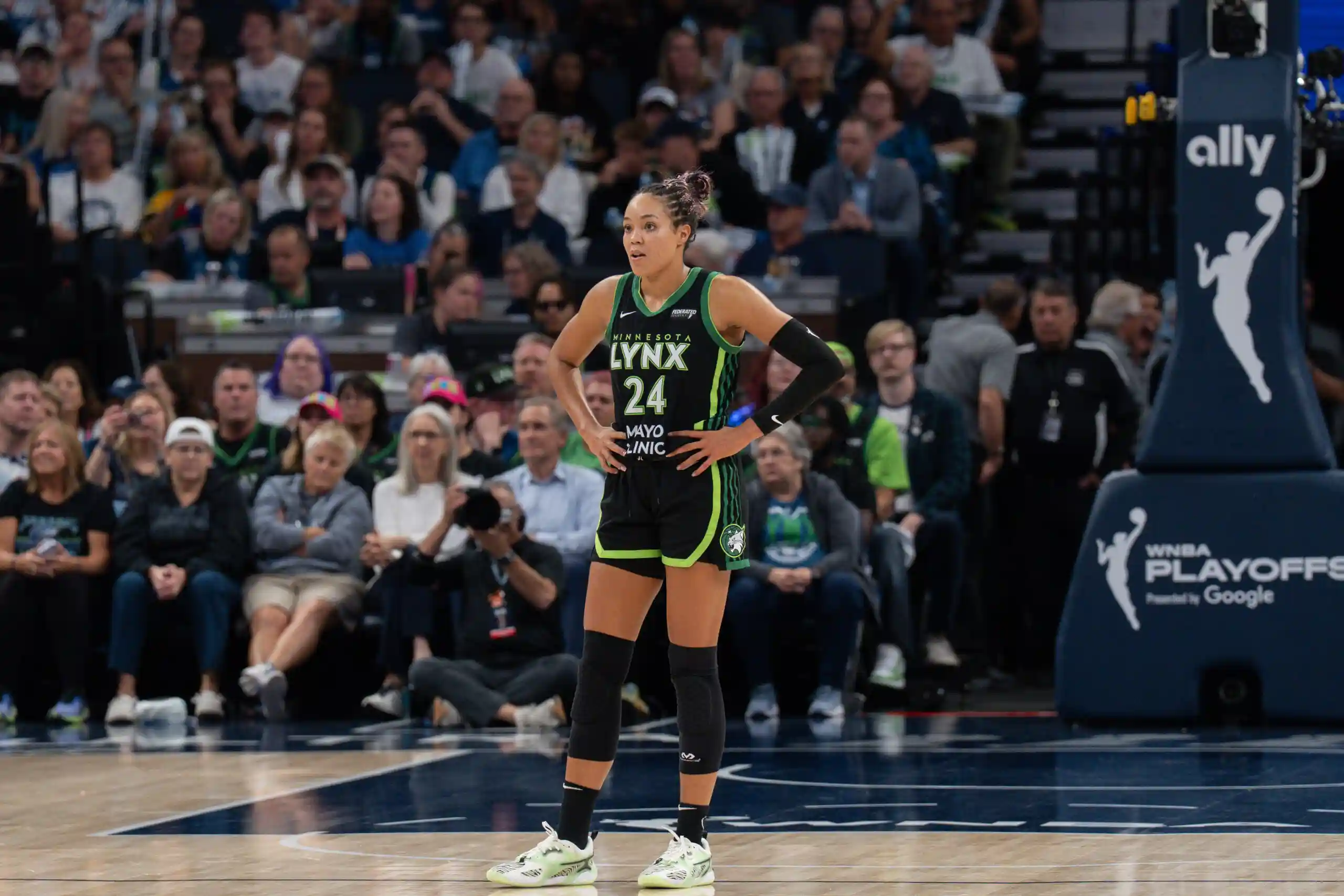
With just three days remaining, the WNBA and Women’s National Basketball Players Association (WNBPA) have until Jan. 9 to reach a collective bargaining agreement. With an extension already in place, several outcomes are possible. Lunar Owls and Minnesota Lynx star Napheesa Collier expressed her opinions and beliefs on the matter Monday night.
Photo Credit: Shawn Mclurkin | Ballislife
Vice President of the WNBPA, Collier, hasn’t shied away when discussing the upcoming CBA. Notably calling out WNBA Commissioner Cathy Engelbert in September, Collier and the players are visibly frustrated. In August, Collier stated the CBA talks lacked “urgency,” and the two sides weren’t close. Skip ahead to January, both sides remain at odds.
RELATED ARTICLES : COLLIER CALLS OUT WNBA COMMISSIONER | WNBA, WNBPA EXTEND CBA
It’s as simple as it sounds: The players are looking for an increased revenue share—essentially a bigger piece of the pie. Without the players, there isn’t a league, and according to ESPN, the parties remain divided on the subject of revenue share. At the center of dispute, this is one point the players are standing firm on. Topics such as increased salaries, practice facilities, working conditions, benefits, and maternity leave remain at the forefront.
According to ESPN’s Alex Philipou, the WNBPA’s latest November proposal included a $12.5 million salary cap in 2026, a maximum salary of $2.5 million, and an average salary of $1 million. Rejected by the WNBA, the WNBPA’s proposal would also include 30% of gross revenue.
WNBA and WNBPA at Odds Over Revenue Share, Player Salaries
There remains an impasse, with the league projecting losses of up to $700 million. It’s clear the league is balancing current CBA negotiations with long-term financial sustainability in mind. Such a loss could compromise the league’s future. The WNBA has since countered with a max salary of $1 million and an average salary of $500,000. As far as revenue, the WNBA’s proposal includes greater than 50% of net revenue.
There’s a key distinction between revenue types, which is a current hot topic in sports. To understand this topic better, it’s best to explain the core difference between the two types of revenue: Gross revenue is before revenue expenses, and net revenue is revenue minus expenses. Such expenses could include operating costs, player salaries, and more. Collier weighed in on the recent negotiations on Monday.
“Our deadline is coming up in a couple of days,” said Collier on the Unrivaled broadcast. “I think you just heard a lot of chatter about what we’re asking for is not sustainable for the business. Being on this side with Unrivaled, I know what it takes to run a sustainable business. I think if they can’t find a model that makes it happen, they need to put people in place who can, because we’ve proven it is possible, there is a way, and we’re thriving in that.”
Set to undergo surgery on both of her ankles, Collier will remain sidelined for the next 4-6 months. With the news, she will miss the entirety of the 2026 Unrivaled season. However, that isn’t stopping her from leading in the entrepreneurial space. Co-founder of Unrivaled—alongside Breanna Stewart—the league has exceeded expectations. Including state-of-the-art facilities, chefs, training rooms, arenas, and practice courts, Unrivaled is setting the standard for what a professional women’s sports league should embody.
Unrivaled Commissioner Micky Lawler detailed several upgrades the League has made in the offseason. The valuation increased to $340 million, and the league has high-profile sponsorship deals with Sephora, Samsung, Under Armour, State Farm, Cheez-it, and more. Securing a multi-year media partnership with TNT has provided the league with ample revenue to pay its players’ salaries above $200,000.
Napheesa Collier with another strong WNBA CBA statement on the Unrivaled broadcast
“Being on this side with Unrivaled, I know what it takes to run a sustainable business. So I think if they can’t find a model that makes that happen they need to put people in place who can.” pic.twitter.com/gl0tFcGWQk
— No Cap Space WBB (@NoCapSpaceWBB) January 6, 2026
Why Revenue Share Matters in the WNBA
Revenue sharing is only a small topic of negotiations, but a critical one. Under the 2020 CBA, the WNBA operates on a fixed model, which provides players with annual growth of 3%. While NBA and WNBA salaries differ widely, players aren’t expecting the massive $300,000—$400,000 paydays awarded in the NBA. These athletes are merely asking for an equal percentage of the pie. Their NBA counterparts receive 49-50% of the NBA’s basketball-related income, while WNBA athletes receive just 9.3%.
The players, instead, are seeking a different structure and a higher revenue share percentage. It’s no secret that the WNBA has seen record-breaking revenue from merchandise, sponsorships, and ticket sales, among other sources. In addition, the WNBA recently signed an 11-year, $2.2 billion media rights deal to broadcast games on Versant starting in 2026.
While the two sides remain divided, the next CBA is figured to be the most transformative in league history. With several topics at stake, this is a critical negotiation not only for the current players but for the future of women’s sports. While the PA opted out of the current CBA, the average player salary for 2025 was just north of $66,000. The combination of a super-max salary of $249,244 and a low revenue share percentage is insufficient for the players.
The players are the product.
Napheesa Collier “Believes” A Deal Will Get Done
With a few days remaining, the clock continues to tick. While a deal could be imminent, there’s also a risk of a work stoppage if no extension is in sight. Players voted to authorize a strike, and a lockout is possible. As Caitlin Clark told the media during USA training camp, “This is the biggest moment the WNBA has ever seen. That’s not something that can be messed up, and we’re going to fight for everything that we deserve. At the same time, we need to play basketball.”
There is truth to Clark’s words; the WNBA is at its peak, experiencing record numbers across the board. With growth off the charts, the league is set to expand to 18 teams by 2030. Not only was the WNBA 2025 season the most-watched on ESPN networks ever, but national viewership (per Engelbert) also increased by 23% as of July 2025. Merchandise sales climbed to 40% by All-Star weekend, along with attendance, which increased to 26% (the highest in decades). While Clark has moved the needle in historic ways, the WNBA will continue to capitalize on NCAA popularity.
Collier shared her thoughts with Lisa Leslie on whether a deal will be reached and on what the players are unwilling to sacrifice.
“I do think a deal’s gonna get done,” said Collier. “We’re standing firm in what we believe in. We’re not going to back down, and we can’t take less. The sport has just grown too much, it would be a disservice to the people who came before us, to the work that we put in, to take less than what we’re owed.”
The CBA was originally set to expire on Oct. 31, 2025, but has since been extended to Jan. 9. With fewer than 72 hours remaining, uncertainty looms over whether a deal will be finalized. Keep up with Ballislife for all WNBA CBA updates.
The post Is a WNBA CBA Agreement Imminent? Napheesa Collier Sounds Off appeared first on Ballislife.com.