The NBA’s 75th All-Star celebration arrives in a fitting setting: the brand-new Intuit Dome in Inglewood, California. A milestone edition of the league’s showcase game unfolds inside its newest arena, in the heart of the league’s media capital, at a time when the balance of power is shifting toward younger and more international stars.
The weekend is being framed as both celebration and experiment. With format tweaks, a USA vs. World mini-tournament, and an expanded global creator presence, the NBA is betting that structure — and stakes — can rekindle competitive fire in an exhibition that has struggled for intensity for well over a decade.
Here are five storylines that will define the 75th NBA All-Star Weekend.
1. USA vs. World: A 75th Anniversary Experiment
For the 75th All-Star, the NBA isn’t just changing jerseys or logos — it’s changing the way the game itself works.
The traditional East vs. West format has already been retired once in favor of captain-drafted teams. Now the league goes further with a USA vs. World mini-tournament structure: two USA squads and one World squad rotating through shortened games before a final segment determines the winner.
Branding around the event emphasizes “U.S. Stars vs. The World,” and the World roster is stacked with international headliners, including Victor Wembanyama, Luka Dončić, and Alperen Şengün — players who already dominate MVP conversations and represent the league’s global rise.
The two USA squads carry depth and name recognition, but the format creates a clean dramatic contrast: the deepest American talent pool versus a concentrated group of international alphas.
League messaging openly positions the format as a celebration of globalization. Around the game, more than 200 global creators have been invited to produce social-first content tailored to international audiences, an acknowledgment that the NBA’s growth is increasingly driven outside the United States.
The central question: does structure change behavior?
Shortened games, tournament-style rotation, and national pride are designed to tap competitive instincts in players who have often treated All-Star as a glorified scrimmage. The NBA is effectively wagering that pride — and optics — will do what pleas for “more effort” have not.
(Photo by David Liam Kyle/NBAE via Getty Images)
2. LeBron James Earns 22 Straight All-Stars and a Career Inflection Point
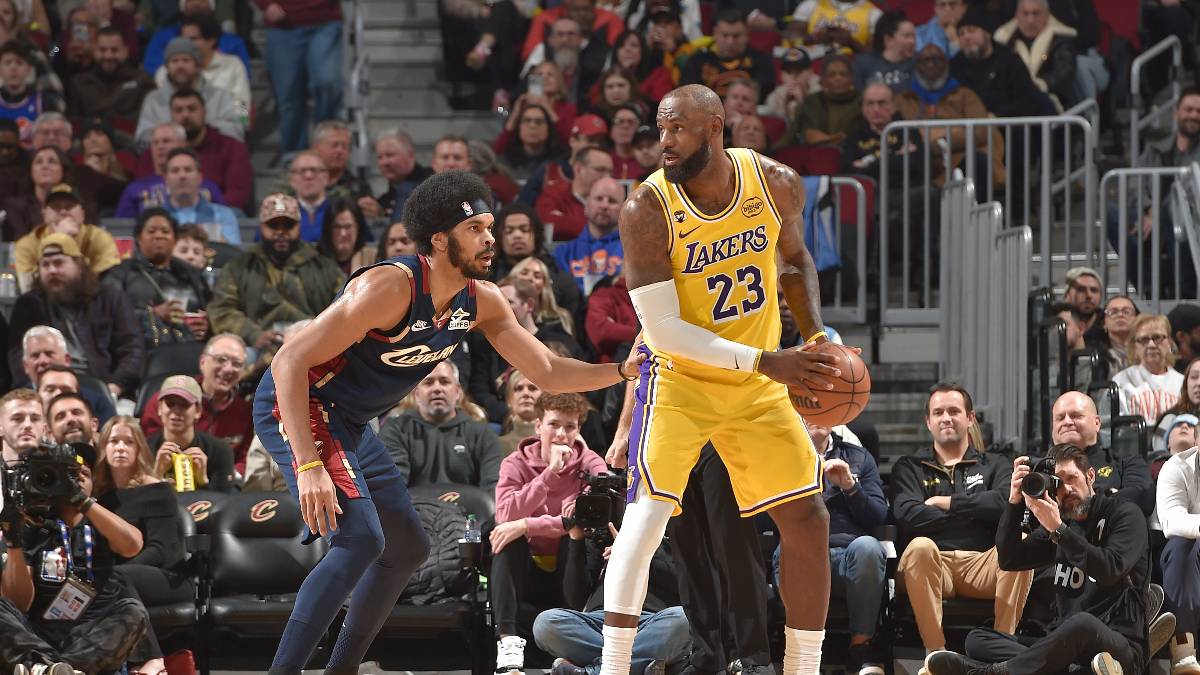
LeBron James enters his 22nd consecutive All-Star selection, extending his own NBA record and reinforcing a streak that began in 2005.
At 41, the milestone feels different.
James missed the first 14 games of the season with sciatica and has managed arthritis and lingering soreness in his left foot. A recent shutdown cost him eligibility under the league’s 65-game minimum for awards, ending a 21-year All-NBA streak — a clean break in a résumé defined by uninterrupted dominance.
Earlier this season, James said he “wasn’t thinking about his All-Star streak” while rehabbing. Yet the context lingers. This is one of the rare All-Star appearances where his presence feels symbolic as much as competitive.
How much will he play? How hard will he push a compromised body in an exhibition setting?
And more quietly — is this it?
All-Star Weekend has long served as a checkpoint in James’ career: a reminder that time keeps advancing while he keeps qualifying. But this year, the calculus feels sharper. The All-NBA streak is gone. Awards eligibility is gone. The margin for physical strain is thinner. The league’s spotlight is shifting toward younger faces, including six first-time All-Stars making their debut on the same stage.
There is no formal farewell attached to this weekend. No announcement, no ceremony. But the question hangs over the building anyway: could this be the last time James enters All-Star Weekend as an active participant rather than an honored guest?
The contrast is unmistakable — a 22nd straight selection on one end, and a wave of new names stepping into All-Star status on the other. It sets up a collision of timelines: the defining figure of the previous era sharing the stage with players already preparing to inherit it.
For two decades, All-Star Weekend has been a guarantee for LeBron James. For the first time, it feels less certain that it always will be.
The Kawhi Leonard and Steve Ballmer saga allegedly started MUCH earlier than you think pic.twitter.com/WxDxfbJTWD
— Dan Le Batard Show with Stugotz (@LeBatardShow) February 11, 2026
3. Kawhi Leonard and Clippers Host Amid Scandal
With All-Star hosted at the new Intuit Dome, Kawhi Leonard occupies the classic “home star” role.
The Clippers have leaned into that positioning. Through “All-Star Homecourt Hoops,” the franchise is distributing 5,600 All-Star–branded hoops across the Inland Empire and greater Los Angeles region, reinforcing Leonard’s deep local ties. The messaging is clear: this is Kawhi’s city, his building, his weekend.
On the court, he has provided the performance résumé to justify that billing. Since the winter holidays, Leonard has played at an elite level, pairing efficiency with volume and reminding the league that when healthy, he remains one of its most surgical scorers.
But the big picture surrounding Leonard is more layered than a simple homecoming.
For years, his name has been central to the NBA’s load-management debate — the tension between long-term health strategy and nightly availability. The league has tightened policies around star rest and injury reporting in recent seasons, aiming to restore fan trust and reduce late scratches in marquee games.
Now, another storyline shadows this All-Star stage.
An ongoing league investigation is examining allegations tied to a sponsorship arrangement between Leonard and the failed fintech company Aspiration. The reporting — most prominently advanced through a multi-episode podcast investigation — alleges that the arrangement functioned as off-books compensation connected to Leonard’s tenure with the Clippers. The core claim is that a substantial endorsement deal may have operated in a way that effectively supplemented his compensation outside traditional salary-cap structures.
Leonard has publicly pushed back on those claims, characterizing the reporting as inaccurate and rejecting the notion that he failed to perform legitimate work tied to the agreement. The Clippers have not faced any announced league discipline, and no public ruling has been issued as of early 2026. The NBA’s investigation remains ongoing.
Still, the optics are unavoidable.
All-Star Weekend is designed to spotlight celebration — a new arena, a host franchise, a marquee name. Yet Leonard enters it as both centerpiece and subject of scrutiny. His career arc has already been defined by mystery injuries, calculated availability and debates over transparency. Now, questions about cap circumvention and third-party compensation add another layer to the narrative.
That duality defines his moment at Intuit Dome.
Leonard stands at center stage as the face of the host franchise’s new cathedral, elevated by community initiatives and elite performance. At the same time, he is emblematic of larger conversations about how stars are compensated, how teams structure deals, and how the league enforces its competitive balance rules.
4. NBA All-Star Saturday Night Format, Field Raises Questions
If Sunday’s game remains unpredictable in intensity, Saturday night may deliver the purest drama of the weekend.
Damian Lillard headlines the State Farm 3-Point Contest despite missing the regular season with a torn Achilles — a surprising and symbolic addition to the field. A former champion in the event, Lillard returns not to influence standings, but to reaffirm identity. For a player whose reputation is built on deep pull-ups and late-clock audacity, the shooting contest offers something simple: a clock, a rack and proof that range survives injury.
He will compete alongside a deep and balanced field: Devin Booker, Donovan Mitchell, Jamal Murray, Tyrese Maxey, rookie Kon Knueppel, plus Bobby Portis Jr. and first-time All-Star Norman Powell.
The contest’s codified format — five-ball racks, designated money balls and deep bonus shots — creates clear stakes and measurable tension. There is no ambiguity about effort. Either the shot falls or it does not.
Saturday night has quietly been reengineered around the same philosophy. The league scrapped the traditional Skills Challenge this year in favor of a revived Kia Shooting Stars event, trading half-speed obstacle courses for a tighter, shot-making relay with visible consequences on every attempt.
With only three events on the slate — Shooting Stars, the Three-Point Contest and the AT&T Slam Dunk Contest — the night is cleaner and shorter, built less like a variety show and more like a three-act competition centered entirely on scoring.
It mirrors fan behavior. When ratings show viewers tune in for made shots and viral dunks, the NBA responds by stripping away excess and doubling down on outcomes that can be understood at a glance.
Kon Knueppel is having an ELITE rookie season:
18.9 PTS
5.5 REB
3.5 AST
48.5 FG%
42.8 3PT%
89.9 FT%
Close to 50/40/90, only 9 players have ever done it – never a rookie pic.twitter.com/eVBv6FroYX
— Hoops Alerts (@TheHoopsAlerts) February 10, 2026
Kia Shooting Stars
The Kia Shooting Stars event is back for the first time since 2015, replacing the Skills Challenge and signaling a deliberate shift toward cleaner, shot-driven competition.
The concept is straightforward: four three-player teams, each featuring two current NBA players and one retired legend, often tied by All-Star history, college connections or family lineage.
2026 Teams:
Team All-Star: Scottie Barnes, Chet Holmgren, Richard Hamilton
Team Knicks: Jalen Brunson, Karl-Anthony Towns, Allan Houston
Team Cameron: Jalen Johnson, Kon Knueppel, Corey Maggette
Team Harper: Dylan Harper, Ron Harper Jr., Ron Harper
The format is a timed, two-round team shooting competition. All four teams compete in Round 1, with the top two advancing to a Final Round.
Each round gives teams 70 seconds to shoot from seven designated spots on the floor. Four locations are worth two points, two are worth three, and the deepest shot is worth four. All three players must shoot from every spot in a predetermined order — and breaking the order costs an attempt.
If there’s a tie in Round 1, teams face a 30-second tiebreaker. If the Final Round ends tied, the entire round is replayed. It is tight. It is clear. It is built around scoring.
AT&T Slam Dunk Contest
The night closes with four participants:
Carter Bryant, San Antonio Spurs
Jaxson Hayes, Los Angeles Lakers
Keshad Johnson, Miami Heat
Jase Richardson, Orlando Magic
The structure remains straightforward: judges, scores, elimination. Clear outcomes. Immediate reaction.
What it does not have — at least on paper — is marquee star power.
Gone are the days when perennial All-Stars used the Dunk Contest as a stage for rivalry and legacy-building. This year’s field leans younger and role-driven, more developmental showcase than superstar summit. That absence is part of the broader Saturday recalibration: less spectacle built on name recognition, more competition built on execution.
The NBA seems comfortable with that trade-off.
In recent years, Saturday has increasingly rivaled — and at times surpassed — Sunday in engagement. Rather than chase nostalgia, the league has leaned into structure and efficiency, tightening the night into three measurable events built around shot-making and highlight moments.
Still, the contrast is notable. The 3-Point Contest carries established stars. Shooting Stars leans into storylines and legacy connections. The Dunk Contest, historically the weekend’s headline act, now depends more on creativity than celebrity.
On a weekend where no one can guarantee how fiercely the All-Star Game will be contested, Damian Lillard walking to the rack after an Achilles tear may offer the sharpest competitive moment of the entire showcase: a shooter, a timer and nothing to hide behind.
Norman Powell on if coming to Miami has allowed him to show the type of leader and player he can be: #HeatNation pic.twitter.com/L7OZqFy9D4
— Zachary Weinberger (@ZachWeinberger) February 5, 2026
5. First-Time All-Stars Signal a Shift in the League’s Hierarchy
On the same night that LeBron James extended his record with a 22nd consecutive All-Star selection, six players added “NBA All-Star” to their résumés for the first time — a clear sign of the league’s evolving hierarchy.
Nearly half of the 14 reserves selected by coaches will be making their All-Star debuts in Los Angeles, and the group reflects a mix of breakout seasons, overdue recognition and organizational ascents.
Deni Avdija becomes the first Israeli player ever named an NBA All-Star, capping a transformative season in Portland and placing him alongside fellow international stars in the debut of the USA vs. World format.
Jalen Duren represents the interior foundation of Detroit’s resurgence, emerging as a force in the paint and a central figure in the Pistons’ climb in the Eastern Conference.
For Chet Holmgren, the selection validates his role as a defensive anchor for Oklahoma City and solidifies his place among the league’s most impactful young two-way players.
Jalen Johnson’s breakout season in Atlanta follows a year interrupted by injury, turning a promising trajectory into full-fledged star status and rewarding one of the league’s most versatile forwards.
After years in the conversation as one of the best players never to make the game, Jamal Murray finally breaks through, his postseason résumé and steady rise culminating in long-awaited recognition.
And in Miami, veteran scorer Norman Powell earns his first nod in his debut season with the Heat, a testament to persistence and reinvention more than early-career hype.
Taken together, the six first-time selections sharpen the weekend’s broader theme. As LeBron continues to extend a record that may never be touched, a new class formally steps into All-Star status — not as future projections, but as present-day headliners.
The post 5 Storylines Shaping NBA’s 75th All-Star Weekend at Intuit Dome appeared first on Ballislife.com.