
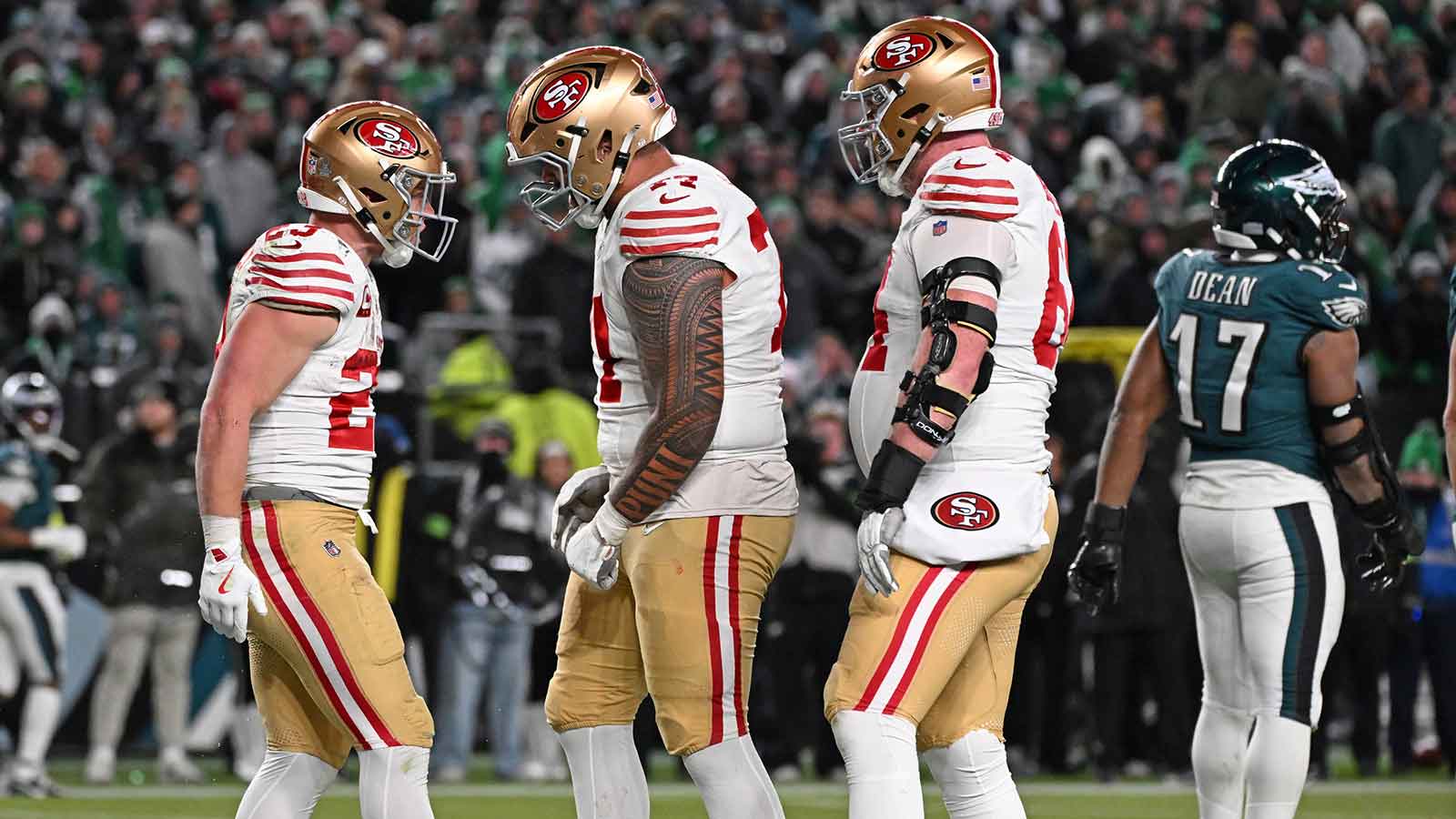
The 49ers started the new year addressing an immediate offensive line vacancy by quickly signing veteran guard Robert Jones after Spencer Burford’s departure.
This move added a player with 30 career starts and familiarity with the Mike McDaniel system, and the team also created some intrigue by declining Trent Williams’ $10 million option bonus while actively negotiating a new deal before the draft.
The overall impact was that while the 49ers secured a short-term option for the interior offensive line, the larger conversation about the left side of the line remained unresolved.
So, the backdrop for San Francisco’s draft outlook, as they have six total picks, with only two in the top 125, and the first wave of free agency did not close off vital roster discussions.
The receiver corps has become older and more stable with the additions of Mike Evans and Christian Kirk, yet it still requires some youthful talent. Concerns persist at left guard despite the Jones signing, and the edge rusher position looks thin, especially with recovery hopes tied to Nick Bosa and Mykel Williams.
Furthermore, the situation regarding Trent Williams’ contract keeps offensive tackle in the spotlight, even though the team publicly downplays it.
OT Blake Miller, Clemson
Mel Kiper Jr. projects that the 49ers will select OT Blake Miller from Clemson at No. 27 in his post-free-agency mock draft. Kiper addresses the roster tension that San Francisco has faced, and he points out not only Trent Williams’ age, he’s 37 and waiting on a contract adjustment, but also that Miller can contribute even if Williams remains.
ESPN also shows that Miller played 97% of his college snaps on the right side, which positions him not just as a future replacement but also as an immediate upgrade over Colton McKivitz, and that flexibility makes him more valuable should the Williams situation drag on or change.
This type of projection fits the 49ers’ drafting style, as they often excel when identifying a significant issue before it fully erupts, and his projection of Miller aligns nicely with this approach, especially for a roster that has already signed Vederian Lowe as insurance but still lacks a clear long-term answer at tackle once Williams retires.
Miller’s fit is also compelling because the 49ers require a player who can stabilize a position, compete early, and allow Kyle Shanahan more options in structuring the offensive front.
San Francisco has spent too much time dealing with one offensive line issue after another, and Kiper’s mock suggests that the franchise is tired of treating tackle as a future problem, simply because they still have a star in Williams.
EDGE Keldric Faulk, Auburn
Field Yates predicts that the 49ers will select Keldric Faulk from Auburn with the 27th pick in his latest two-round mock draft, and his reasoning is based on the current state of the edge rusher group following free agency, rather than a broad assessment of player talent.
Yates emphasizes that even with Nick Bosa and Mykel Williams expected to return from injuries, the 49ers still need to strengthen their edge position, and he describes Faulk as too talented to overlook due to his size, run-defense ability, and significant developmental potential.
A notable factor is Faulk’s age; he won’t turn 21 until September, making him a long-limbed, adaptable defender. Coaching staff could envision him becoming much more impactful once he transitions to the NFL from college football.
This selection is ideal for those who believe that free agency has sufficiently bolstered the offense, thereby allowing the 49ers to focus on enhancing their front seven. The addition of veteran players has provided quarterback Brock Purdy with more support, eliminating the perception that he is playing behind an inadequate offense.
However, the defense still faces some uncertainty, and the retirement of Bryce Huff and the injury concerns surrounding Bosa and Williams have made the edge rusher position less secure than the 49ers would like. Faulk offers Yates an opportunity to address these concerns without choosing a player whose potential is already limited, and he is not viewed as a finished product as a sack producer but rather as a high-upside prospect with traits that defensive line coaches appreciate, particularly when they have time to develop them.
For a team aiming to remain competitive, taking a chance on a player like Faulk is far more justifiable than for a team in disarray.
TE Kenyon Sadiq, Oregon
Daniel Jeremiah has consistently mocked Kenyon Sadiq to the 49ers, highlighting him as an exciting fit for the team. This marks the second time he has done so this year, and his reasoning focuses on how Sadiq would serve as a dynamic addition to Kyle Shanahan’s offense.
Sadiq is not just a standard in-line tight end because he is versatile and possesses receiver-like speed and impressive burst. His unique profile forces defensive coordinators to confront challenging questions about personnel and spacing.
The brilliance of this mock draft lies in its rejection of the false dichotomy between “need” and “weapon.” While many analysts might suggest that the 49ers need to target positions like tackle or edge at this point, Sadiq represents a different strategic vantage point.
Although the additions of Mike Evans and Christian Kirk bolster the receiving corps for 2026, they do not make the offense younger, more cost-effective, or more dynamic in the long run, and Sadiq could provide Shanahan with a player capable of transforming formations, operating effectively in the middle of the field, stretching the seams, and ensuring the offense remains fresh and adaptable over time.
In a draft class where several trench options may be similarly valued, it’s clear why Jeremiah continues to advocate for giving Shanahan a player whose versatility would allow him to contribute in numerous roles.
WR Omar Cooper Jr., Indiana
In his most recent post-combine mock draft for ClutchPoints, Tim Crean projected that the 49ers would select WR Omar Cooper Jr. from Indiana at No. 27. He describes Cooper as a versatile option whose athletic testing hints at more potential than many initially believed.
The timing of this projection is important, as it comes before the conclusion of free agency, yet the central idea remains relevant.
In fact, March clarified the situation further, and while the 49ers brought in veteran receivers to help immediately, like Mike Evans and Christian Kirk, they still require younger talent for the future. As they plan to support Brock Purdy, they need to think beyond just the current season.
Crean’s appeal for Cooper lies in his ability to do a little bit of everything, and this type of all-purpose receiver has significant value in a Shanahan offense.
Moreover, there are economic considerations that make this fit more sensible than it may initially seem. The 49ers aim to remain competitive without assuming that every expensive veteran solution will be permanent, and Cooper wouldn’t have to be the standout player immediately; instead, he would focus on learning, contributing, and eventually assisting San Francisco in transitioning from an older group of receivers to a fresher, more sustainable one.
Crean compares Cooper’s style to the versatile pass catchers that have succeeded in San Francisco’s system previously. Even if the comparison is a bit generous, the underlying logic remains strong. Teams that rely on spacing, motion, and yards after the catch tend to prefer receivers who can fulfill multiple roles, and Cooper fits that description well.
What makes the 49ers particularly interesting compared to other teams is that free agency did not provide them with a clear, singular solution; it instead narrowed their options.
The team could still choose to draft a tackle if the situation with Williams remains unresolved, or they might select an edge rusher if they feel the defensive line needs another young player before training camp begins.
Alternatively, they could opt for another offensive player if the front office believes that enhancing Shanahan’s arsenal with a new mismatch or a younger receiver is the best path to maintaining their competitiveness, and this uncertainty is not a sign of confusion because it indicates that the roster possesses enough baseline competence to draft based on preference rather than panic, which often leads to better first-round decisions.
The post 49ers’ 2026 NFL Mock Draft roundup after NFL Free Agency appeared first on ClutchPoints.
