
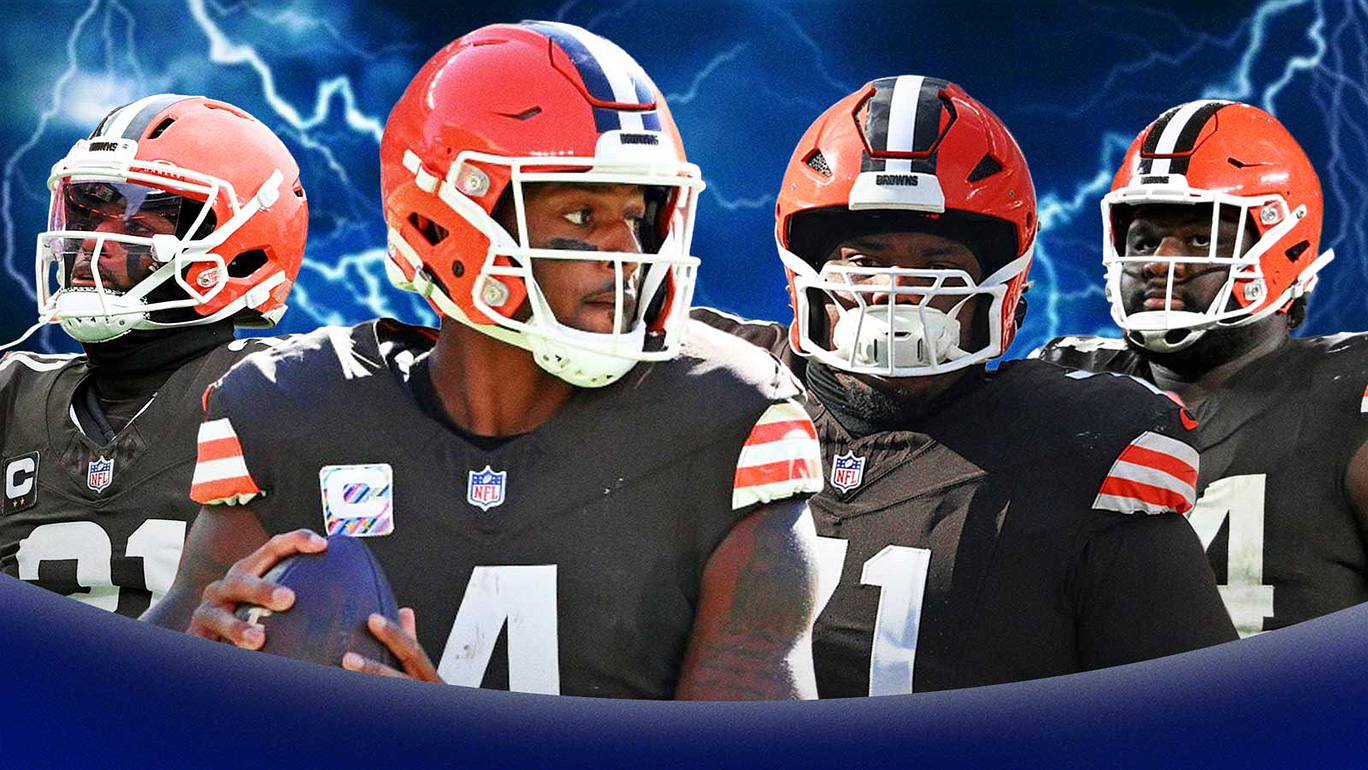
For years, the Cleveland Browns operated with calculated aggression. They restructured contracts and pushed money into future seasons. They have also bet that elite defensive play plus a stabilized quarterback situation would justify the financial gymnastics. Now, the future has arrived, and it’s expensive.
The 2026 offseason isn’t about adding a marquee free agent or making a splash trade. It’s about survival. General manager Andrew Berry must maneuver through one of the tightest cap situations in the league. He also needs to preserve the core of a roster that, despite a 5-12 record, still features All-Pro talent. For Cleveland, clearing cap space isn’t optional but urgent.
Defensive brilliance, offensive turmoil
Katie Stratman-Imagn Images
The 2025 Browns season was a year of painful transition and defensive dominance that ultimately yielded a last-place finish in the AFC North. Deshaun Watson missed the entire campaign while rehabbing a second Achilles surgery. That left the offense initially in the hands of Joe Flacco and eventually a rotation of young quarterbacks. The results were uneven at best, as Cleveland finished 31st in scoring.
Yet the defense under Jim Schwartz remained elite. Myles Garrett authored a historic 23-sack season. That rewrote franchise and league record books while anchoring one of the NFL’s fiercest units. Despite that dominance, the imbalance between offense and defense proved too wide to overcome.
The year ended with sweeping change. Kevin Stefanski departed, and Todd Monken was brought in to reimagine the offense. The talent remains, but the cap sheet complicates everything.
Fiscal minefield
Heading into 2026 free agency, the Browns sit roughly $19.5 million over a projected $301-$305 million cap. Nearly 25% of that cap space is consumed by Watson’s staggering $80.7 million hit. That’s the largest in league history.
Cleveland has leaned on restructures annually to stay afloat. However, void years are stacking. Aging veterans now carry inflated cap numbers. Joel Bitonio’s $23.5 million void charge and Dalvin Tomlinson’s dead money pressures illustrate a franchise reaching a financial crossroads.
Berry can’t simply trim around the edges. He must execute aggressive, structural moves to regain breathing room.
QB Deshaun Watson restructure
There’s no avoiding the elephant in the room. Watson’s cap hit makes every other conversation secondary. The Browns have pressed the restructure button before. They’ll have to do it again.
They must convert approximately $44.7 million of Watson’s $46 million base salary into a signing bonus. They must also spread it across remaining void years. That would create roughly $35.7 million in immediate cap relief. It’s procedural at this point, almost mechanical.
The catch is long-term consequence. This maneuver pushes future dead money into 2027 and beyond. That would effectively tie Cleveland to Watson for at least one more season. A 2026 release would be financially impossible. Still, without this restructure, nothing else matters. It is the foundational move that unlocks flexibility for every other adjustment.
Post-June 1 release of CB Denzel Ward
This is where cap management becomes emotional. Denzel Ward has been a cornerstone of the Browns’ secondary. He is one of the franchise’s most recognizable faces. By 2026, though, he will be approaching 30 with a history of injuries and a cap number that strains allocation priorities.
Cutting Ward outright before June 1 would accelerate too much dead money. However, designating him as a Post-June 1 release spreads the impact. That could free $15-18 million in 2026 cap space.
The logic is painful but clear. Cleveland must prioritize trenches and quarterback infrastructure over high-priced veteran corners. Reallocating Ward’s cap figure could fund multiple roster needs.
Extend or manage Joel Bitonio’s void year
OL Joel Bitonio remains a franchise icon. Still, his contract structure presents a 2026 dilemma. A $23.5 million void-year charge looms despite no remaining years on the deal.
The Browns have two realistic options. They can negotiate a one-year legacy extension. That would lower his 2026 cap hit to roughly $8-9 million while keeping a respected veteran in place. Alternatively, if retirement becomes reality, a Post-June 1 designation could prevent the entire $23.5 million from accelerating immediately. Either path saves approximately $14-15 million in short-term relief. That money is critical for rebuilding an offensive line that struggled throughout 2025.
Trim the trenches
Cap survival often hinges on smaller, cumulative moves. Cornelius Lucas, a veteran swing tackle, carries a modest but expendable contract. Releasing him would save roughly $2 million with minimal dead money. That’s incremental but necessary.
Dalvin Tomlinson presents a more complex case. While still productive, his cap number outweighs his rotational role. A Post-June 1 release could generate several million in savings. That would ease pressure without destabilizing the defensive front.
In reset years, teams move on from 30-plus veterans whose contracts no longer match their snap counts. Cleveland is entering exactly that phase.
Cleveland’s next chapter
© Sam Greene/The Enquirer / USA TODAY NETWORK via Imagn Images
Combined, these four moves could swing the Browns from nearly $20 million over the cap to operating with workable flexibility. Watson’s restructure is mandatory. Ward’s potential release is strategic. Bitonio’s contract requires creativity. Trimming veteran depth rounds out the puzzle.
This is a survival blueprint. The Browns still possess elite defensive talent and a coach committed to offensive reinvention. However, until the cap sheet stabilizes, splash moves are off the table. Cleveland’s path back to contention begins with disciplined, uncomfortable subtraction. In 2026, the Browns won’t just be rebuilding their offense. They’ll be rebuilding their balance sheet.
The post 4 moves Browns must make to clear salary cap space in 2026 NFL offseason appeared first on ClutchPoints.
