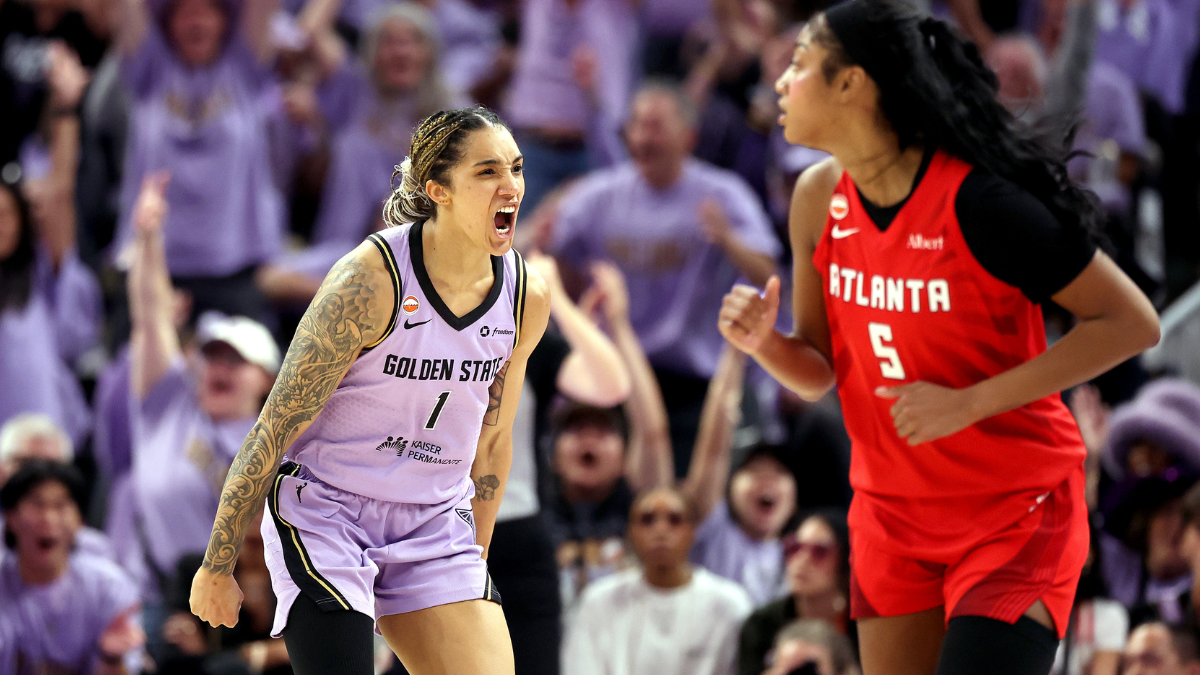
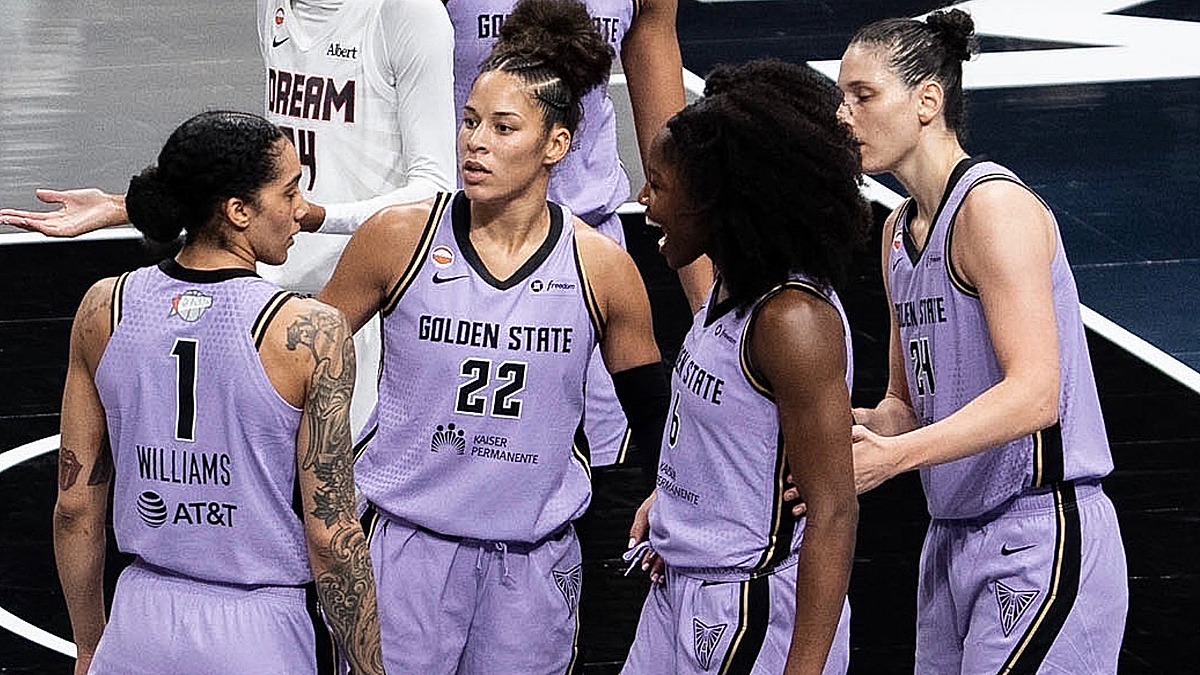
Head coach Natalie Nakase accepted responsibility for her Golden State Valkyries’ shortcomings after Game 3 of the 2026 WNBA Finals. Two days later, her players answered.
Photo: Jineen Williams (Ballislife)
The Valkyries rediscovered their defensive identity, embraced a starting lineup change, and weathered Atlanta’s second-half pressure to win 67-62 on Saturday afternoon evening the best-of-seven Finals at two games apiece. The series returns to Chase Center for Game 5 on Monday (8 p.m. ET, USA/CNBC/Peacock).
The @valkyries take Game 4 on the road
The Valks defeat the Dream, 67-62. They tie the series at 2-2, as they head back home to Golden State!
Gabby Williams: 17 PTS | 5 REB | 3 AST | 3 STL
Veronica Burton: 13 PTS | 5 AST | 3 REB | 2 STL | 2 3PM | 2 BLK
Tiffany Hayes: 13 PTS | 5 REB
Cecilia Zandalasini: 10 PTS | 3 STL
#WNBASeason30 | #2026WNBAFinals
— WNBA (@WNBA) October 24, 2026
Four Valkyries players finished in double figures, led by Gabby Williams, who had 17 points and five rebounds. Tiffany Hayes and Veronica Burton each scored 13 points, while Cecilia Zandalasini finished with 10. Defensive specialist Kiah Stokes grabbed 16 rebounds and blocked three shots.
Rhyne Howard led Atlanta with 19 points and eight rebounds. Jordin Canada and Isobel Borlase both had 10 points. Angel Reese, the Finals MVP favorite, managed just eight points. She also grabbed nine rebounds.
After falling behind 2-1, the turnaround began with conversations and film sessions that forced Golden State to confront what went wrong in consecutive losses. It translated into greater ball pressure, more connected defense and a willingness to play through contact.
Gabby Williams is a road warrior
Her 17 PTS, 5 REB, 3 AST & 3 STL helped the @valkyries tie the series 2-2!
#WNBASeason30 | #2026WNBAFinals https://t.co/9sf8A6KEhO
— WNBA (@WNBA) October 24, 2026
“Keeping a team like Atlanta to 62, that’s who we are,” Nakase said.
Here are five takeaways from Game 4:
1. Different lineup, familiar identity
Nakase changed her starting lineup on Saturday, as Hayes and Kaila Charles went in while Zandalasini and Kayla Thornton took on reserve roles. The response depended on something already established within Golden State’s locker room: accepting whatever role the team needed.
“The best thing about our team is like no one cares who starts,” Nakase said. “We can do that because we have a really selfless team, egoless team.”
The adjustment added energy without sacrificing bench contributions. Nakase praised Zandalasini’s comfort in getting to her offensive spots and Thornton’s physicality at center. For a team that struggled to recognize itself in Games 2 and 3, embracing change mattered.
Nakase said the two days between games included accountability through film and conversations in which she prioritized listening.
“I need to know what they’re thinking, what they’re feeling,” she said.
The result was a team better connected on both ends, including through eye contact and pointing when the crowd made verbal communication difficult.
2. Stokes and Williams reconnect the defense
Stokes’ protection near the basket gave Golden State’s perimeter defenders the confidence to apply pressure.
“I’m trying to be the last line of defense for our team that allows my guards to bring pressure a little more,” Stokes said. “I know they have confidence that I have their back.”
Her assignment against Reese required patience and discipline.
“For me it was just trying to make every look that she had of the basket difficult,” Stokes said.
Williams identified increased ball pressure as the adjustment she liked most, while Nakase described her defense as being on an “elite, elite level.”
Williams’ performance also followed a personal reckoning after Game 3. Speaking up afterward increased her sense of responsibility to deliver.
“I didn’t like my last game,” Williams recalled. “I didn’t like who I was in that last game … If I want to lead my team, I have to be the one that sets the tone, and I have to lead by example as well.”
3. Hayes and Burton supply the closing resolve
Golden State’s defensive response put it in position to win. Its guards helped finish the job.
Williams and Stokes emphasized Hayes’ importance in the fourth quarter, especially when Williams struggled to find her shooting touch.
“Huge, absolutely huge,” Williams said. “Especially, you know, I was having a hard time seeing the ball go in, but that’s why we rely on each other.”
DIFFERENCE. MAKER.
Tiffany Hayes is taking over in the fourth!
GSV-ATL | NBC | Peacock | #WNBASeason30 | #2026WNBAFinals
Tap to watch: https://t.co/Oyxt6PnfLA https://t.co/DMOgQzfDdX
— WNBA (@WNBA) October 24, 2026
Burton’s resilience impressed Nakase throughout the physical contest. The coach repeatedly checked whether Burton needed a break but the player she labeled “the heart and soul of the team” repeatedly said she was fine.
That persistence carried into a crucial late possession, when Burton wanted the responsibility of attacking her defender.
“She said, ‘I got it,’” Nakase said. “She just attacked her matchup and closed it and really calmed us down.”
4. Atlanta’s response too late
The Dream anticipated a more aggressive opponent. They failed to match that urgency early.
“They just came out aggressive, and we didn’t come out ready to match that,” Howard said. “I think they forced us into some untimely decisions, and they capitalized off of it.”
Coach Karl Smesko credited Golden State’s physical defense and offensive rebounding. Atlanta needed better ball security and shot selection, then compounded its difficulties by missing good opportunities.
COMING DOWN TO THE WIRE
Rhyne Howard’s and-1 cuts the deficit to 66-61!
GSV-ATL | NBC | Peacock | #WNBASeason30 | #2026WNBAFinals
Tap to watch: https://t.co/Oyxt6PnfLA https://t.co/7UjVA5QgVU
— WNBA (@WNBA) October 24, 2026
The second-half response encouraged Smesko. The circumstances requiring it did not.
“We can’t put ourselves in that position where you’re playing a great defensive team and you’re having to come back from double figures,” Smesko noted.
Reese saw Golden State’s 26-15 second-quarter triumph as a decisive stretch.
“We applied a lot of pressure,” Reese said. “But we can’t wait until the second half to do it.”
5. Reese accepts responsibility
Reese’s assessment of her difficult afternoon began with her own execution.
“I think I rushed a lot of my shots,” she said. “I didn’t take my time and finish around the basket like I’ve been doing in the last three games.”
Asked about Stokes’ defense, Reese emphasized the familiarity of the matchup and returned to the same explanation: she rushed. She also accepted responsibility for turnovers, citing offensive fouls and passes she failed to deliver on time.
Atlanta’s free-throw shooting offered another measurable regret. Reese pointed to the Dream going 22-for-31, leaving nine points at the line in a five-point defeat. She said the path forward starts with restoring Atlanta’s identity and sustaining it from the opening tip.
“Just getting back to who we are, our identity, being the enforcers, and just knowing who we are,” Reese said of the way to get momentum back in Game 5.
W.G. Ramirez is a veteran sports writer from Las Vegas and a Staff Writer at Ballislife.com. Follow him on X at @WillieGRamirez
The post 2026 WNBA Finals: 5 Takeaways From Valkyries Tying Win appeared first on Ballislife.com.